
A majority of economists predicted RBI Governor Raghuram Rajan would leave policy rates unchanged on Tuesday and expected a dovish commentary, as crude oil prices and inflation cool off.
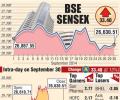
The 30-share Sensex ended up 33 points at 26,630 and the 50-share Nifty closed 6 points up at 7,965.

India is better positioned to face external shocks emanating from increasing geopolitical tensions, the aftermath of the COVID pandemic and the inevitability of climate change, Reserve Bank Deputy Governor Michael Debabrata Patra said on Monday. Relative to macroeconomic configurations in 2013 when India was described as one of the fragile five countries, he said, "India is better positioned currently, as its macroeconomic fundamentals have improved significantly, and external sector indicators point to the availability of enough cushions to manage external shocks." He was speaking at a conference on 'Growth And Development in the BRICS Economies' organised by the Delhi School of Economics (DSE) and the Indian Statistical Institute (ISI).

Rate cuts are unlikely to be aggressive, in our view.

This is contrary to the expectations of a majority of analysts predicting for another hike given the rise in inflation lately, including domestic ratings agency Icra
.jpg)
The rupee had earlier this month touched a life time low of 61.21 to a dollar.

Reserve Bank of India (RBI) on Friday kept the benchmark interest rate unchanged at 4 per cent and decided to continue with its accommodative stance despite rising inflation. This is the 11th time in a row that the Monetary Policy Committee (MPC) headed by RBI Governor Shaktikanta Das has maintained the status quo. RBI had last revised its policy repo rate or the short-term lending rate on May 22, 2020 in an off-policy cycle to perk up demand by cutting the interest rate to a historic low.

The Reserve Bank may be hitting the end of its tolerance for high inflation and will most likely hike interest rates in the first half of 2022, analysts said on Friday. The central bank will also start rolling back its accommodative policies which have led to easy liquidity conditions, they said. The view from analysts came even as inflation cooled down to 5.6 per cent for July, after two months of breaching the upper end of the RBI's tolerance band of 6 per cent.

Is the worst over for Indian banks? The past two years saw them ride on treasury trades as deposits soared and credit growth dipped sharply. Gross and net non-performing assets (NPAs) moved south, and the provision coverage ratio (PCR), capital buffers, and profitability indicators are back at pre-pandemic levels. So, what's the plot ahead?
Though there has been policy progress in Europe, the global economic backdrop remains decidedly challenging, Eskesen said, adding domestic conditions have remained fairly stable, though, and underlying inflation has stayed firm.
The Reserve Bank on Friday announced that it will pump in Rs 12,000 crore (Rs 120 billion) in the market on June 12 by buying government securities to ease the liquidity situation.

The RBI, which has been keeping rates at an elevated level citing high inflation, wants it to come down to 6 per cent by January 2016.
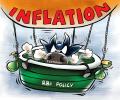
Analysts say RBI will cut rates because the liquidity crunch that began this time last year is still hurting the economy and also with an eye on the August industrial production numbers, which showed a contraction by 1.1 per cent -- the steepest in seven long years.
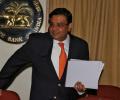
Fitch said the full implications of Patel's resignation will only become clearer once there is some indication of the RBI's policy approach under his replacement, Shaktikanta Das

The dollar-rupee rate could move in the opposite direction if dollar policy rates rise and the FPIs sell in December, says Devangshu Datta.

Retail inflation rose 4.38 per cent year-on-year in November, the slowest pace in data going back to January 2012.

Corporate houses believe RBI must cut rates to boost investment in the system.

Issuers are currently not comfortable with the bids they have been getting for their bond offerings.

Adopting a wait- and-watch approach ahead of US Fed meeting

Reliance Industries was the top laggard in the Sensex pack, shedding over 2 per cent, followed by UltraTech Cement, SBI, Tata Steel, HDFC and Axis Bank. NSE Nifty fell 56.40 points to 16,238.20.

The government is likely to present a "run-of-the-mill" budget with an fiscal slippage to 3.7 per cent of the GDP in the next fiscal from an earlier target of 3.5 per cent, a Nomura report says.
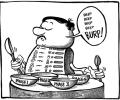
The headline seasonally adjusted Nikkei India Composite PMI Output Index, that maps both the manufacturing and services sectors, rose from 53.3 in June to 54.1 in July.

The repo or short term lending rate remains unchanged at 6.75 per cent and the reverse repo rate at 7.75 per cent.

SBI was the top gainer in the Sensex pack, rallying over 10 per cent, followed by Kotak Bank, Dr Reddy's, UltraTech Cement, ITC and HDFC Bank. On the other hand, Axis Bank, Bharti Airtel, ICICI Bank, Maruti and HCL Tech were among the laggards.

However, it may still not change its stance on the policy rate as inflationary pressures are coming from high commodity prices.
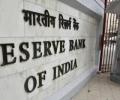
Tuesday's policy announcement had a regulatory and development component.

Most say a rate cut could come in RBI's June policy.

"We did not abuse RBI governors," says Chidambaram.

If Chinese growth starts falling, sharply or otherwise, the risk on trade might reverse.

'If rate cuts happen, bond yields will come down and investors will make mark-to-market capital gains on them.'

A combination of factors, including heavy investments in US Treasury bonds and dollar sales at a healthy profit, facilitated the Indian central bank in transferring a record surplus of Rs 2.11 trillion to the government for 2023-24 (FY24). The RBI's dollar purchases increased in FY24, supported by robust capital inflows endorsing the economy's health.

Numbers could be classified further into (140) marketing and (160 or 161) for service calls to easily identify the purpose of the call in the future.

The headline HSBC India Purchasing Managers' Index -- a composite gauge designed to give a single-figure snapshot of manufacturing business conditions -- stood at 54.5 in December, up from 53.3 in the prior month.

Improved credit profile may make you eligible to transfer your existing home loan to another lender at a much lower rate.

The general elections in April/May 2024 are expected to add volatility to the Indian markets, keeping investors on their toes.

India's services sector activity continued to expand in September, supported by favourable underlying demand amid the easing of COVID-19 restrictions, but lost some momentum from August's 18-month high level, a monthly survey said on Tuesday. The seasonally adjusted India Services Business Activity Index fell from 56.7 in August to 55.2 in September, but remained well above its long-run average. "Despite easing from August, the rate of expansion was marked and the second-fastest since February 2020," the survey said.

'India's emergence as a top crypto market comes despite a regulatory and tax environment that can be challenging for the industry to navigate.'

Food prices saw a sharp rise of 3.12 per cent in March compared to 2.69 per cent in the previous month

In the Sensex pack, Sun Pharma was the biggest gainer, rallying 4.48 per cent, followed by Bajaj Auto, Tata Motors, Coal India, Hero MotoCorp, Maruti and HCL Tech, rising up to 3.01 per cent. While, RIL, PowerGrid, HDFC, L&T, IndusInd Bank, NTPC and Bajaj Finance declined up to 1.50 per cent.

New Reserve Bank of India chief makes his first monetary policy statement on Friday with expectations he may scale back some of the emergency measures that have helped the rupee bounce from a record low.
